
Dr. Jürgen Skripalle
MANAGING DIRECTOR CENTER OF COMPETENCE AFM

With KANALIS we record water levels, flow rates, and sewer conditions in real time, thereby optimizing water distribution efficiently and conserving resources. Precise data increases operational reliability and enables targeted control in water management.
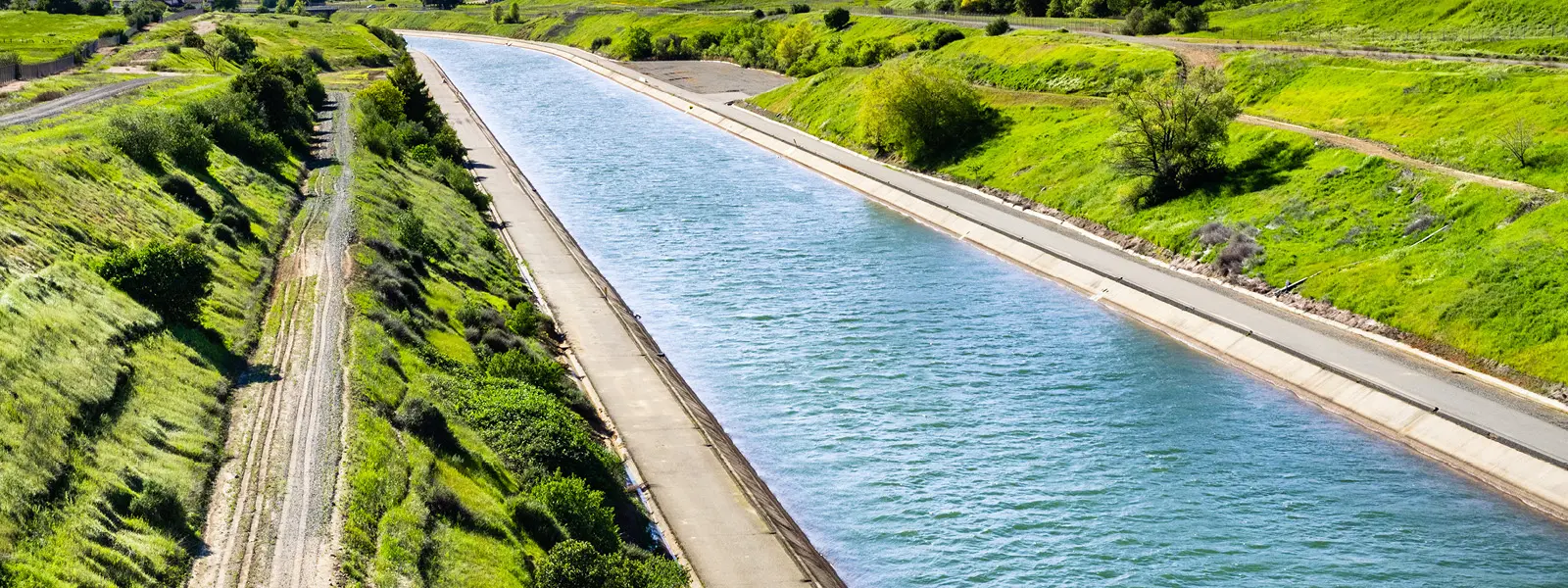
With up to 10 acoustic measurement paths, our KANALIS system delivers outstanding accuracy, repeatability, and linearity across the entire measuring range and precisely calculates the flow rate based on cross-sectional geometry, water level, and velocity according to ISO 6416. Automatic velocity profile approximation eliminates time-consuming on-site calibrations and takes even complex flow conditions into account. The platform-independent web interface with integrated Wi-Fi and LAN access allows for easy configuration, operation, and real-time remote monitoring of the system – anytime and from any mobile device.
Open channels or closed pipes from 1-100m wide; applications under stationary non-uniform flow conditions (e.g. locks, gates and weirs); ship canals; irrigation canals; hydroelectric power plants; industrial wastewater and sewage treatment plants.
Sensors continuously measure water level, flow rate and outflows in canals and pipes.
Automated systems open or close sluices and valves to optimally irrigate fields.
Precise measurements reduce overflow, evaporation, and water loss.
Integrating rainfall data and soil moisture forecasts ensures efficient irrigation.
Farmers can use water in a targeted and cost-efficient manner, independent of manual intervention.
Historical measurement data enables better planning of irrigation cycles and infrastructure measures.
Using water resources sparingly increases the environmental sustainability of agricultural production.
KANALIS is suitable for open channels or closed pipes from 1 to 100 m wide and reliably measures flow rates even under uneven flow conditions such as locks, gates, or weirs. It is ideal for clean or slightly polluted water in rivers, shipping canals, irrigation systems, hydroelectric power plants, industrial wastewater, and sewage treatment plants.
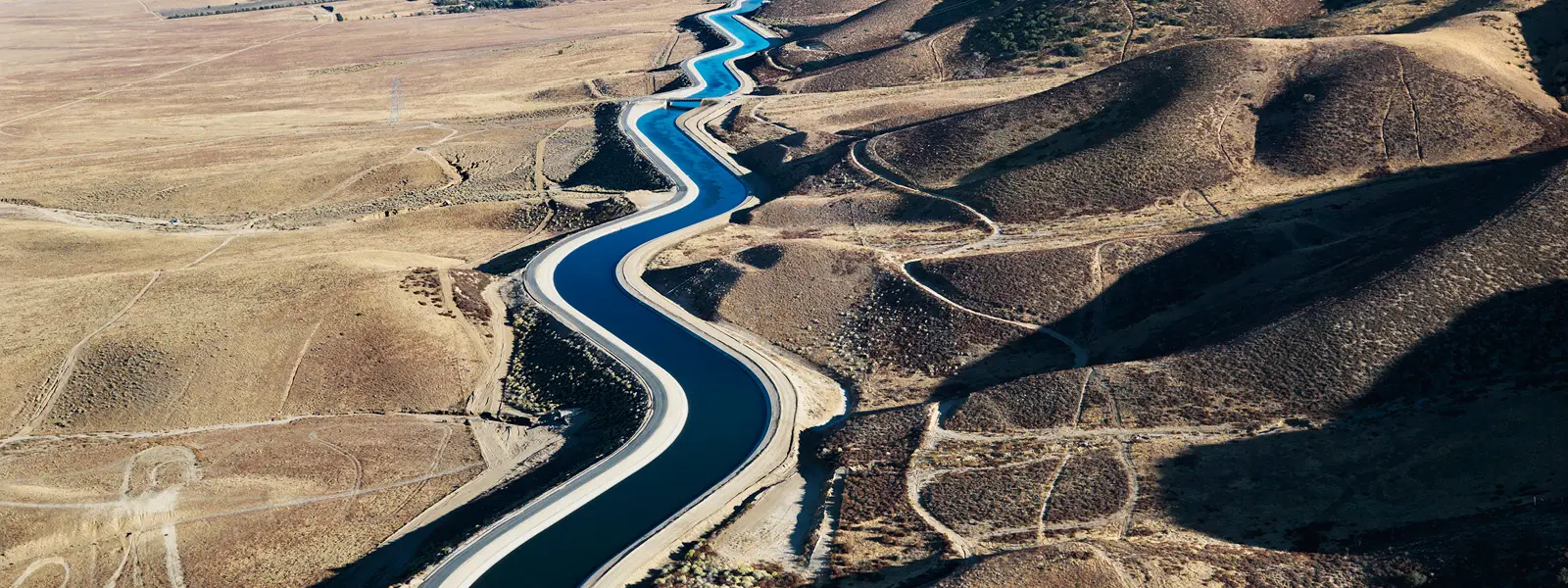
KANALIS is an ultrasonic flow meter designed for continuous flow measurement in open channels such as artificial canals, tunnels, and aqueducts. Flow measurement allows for the prevention of long-term water losses and the continuous monitoring and control of the flow rate. Flow rate is also a crucial factor in maintaining minimum ecological flow levels and in the operation of weirs and sluice gates.

The KANALIS measuring principle is based on the transit-time difference. An ultrasonic pulse is sent with and against the flow direction, and the difference in signal transit time is evaluated. In combination with water level measurement and cross-sectional area KANALIS determines the precise flow rate across its entire measuring range. KANALIS can measure in up to 10 acoustic paths, e.g., in five planes with two intersecting paths each.
Our KANALIS system guarantees the highest measurement accuracy by eliminating cross-currents through a crisscross arrangement of four transducers. Multiple acoustic paths automatically adapt to fluctuating water levels, ensuring a consistently accurate flow profile. Furthermore, thanks to paths layered in parallel planes, time-consuming hydrometric calibration is eliminated – for reliable, low-maintenance measurements.
Are you interested in our services or another customer segment? We look forward to hearing from you.
Do you have any further questions? Don't hesitate to contact us!
Most open channel flowmeters require regular recalibration and maintenance to remain accurate—site visits, hydrometric surveys, and updated calibration factors increase costs and lead to gaps in data reliability. KANALIS is an ultrasonic open channel flowmeter system designed for permanent, unattended operation. It measures the complete velocity profile across the cross-section using multiple acoustic paths and requires no on-site calibration after commissioning. GWF KANALIS covers channels from 1 to 100 meters wide, complies with ISO 6416, and has been deployed worldwide in irrigation networks, wastewater treatment plants, and hydropower inlets.
Inaccurate flow measurement at the inlet of a wastewater treatment plant directly leads to reporting errors, permitting risks, and process inefficiencies. In a wide inlet channel, a single measuring point cannot represent the complete velocity profile across the cross-section and delivers lower accuracy under real-world conditions. Simultaneously, sensors positioned in the flow path are subject to fouling and buildup, which is a constant operational reality in wastewater applications. GWF KANALIS utilizes multi-path ultrasonic measurement to reconstruct the complete velocity profile across the channel. The sensors are mounted on the sidewalls to minimize fouling, thus providing the precise, low-maintenance flow recording required for inlet measurements.
Documenting ecological minimum flow rates for regulatory purposes requires stationary flow measurement in open channels that provides a continuous, verifiable record – not periodic estimation. KANALIS was specifically designed to document officially authorized water withdrawals and ecological minimum flow rates in open channels. Using multiple acoustic paths, the system measures the complete velocity profile, complies with ISO 6416, and provides the long-term continuous data recording with integrated logging and remote transmission required by environmental authorities. GWF KANALIS has been deployed worldwide for documenting ecological minimum flow rates at hydropower intakes, weirs, and water withdrawal points.
In large rivers and wide waterways, measurement error compounds with scale — a radar or single-path system measuring surface or mid-depth velocity across a wide channel and applying a theoretical profile factor can produce errors that make flood forecasting, abstraction licensing, and environmental flow management unreliable. The only way to achieve defensible accuracy at this scale is to measure the velocity profile directly across the full cross-section at multiple depths. GWF KANALIS spans channels up to 100 metres wide using multiple acoustic paths, complies with ISO 6416, and provides the continuous, calibration-free flow record needed for hydrological modelling, flood forecasting, and officially documented water abstraction. For rivers beyond 100 metres, GWF Fluvius extends the same multi-path principle to waterways up to 1000 metres wide.
Adding flow measurement to an existing irrigation canal has traditionally meant building a flume or weir — civil works that create head loss, trap debris, and require significant construction investment. KANALIS takes a different approach: sensors are installed into the existing channel cross-section, measuring the full velocity profile across the channel using multiple acoustic paths, with no flume or weir required and no on-site calibration needed after commissioning. GWF supports customers from site assessment and sensor configuration through to installation and commissioning, ensuring the system delivers reliable, accurate flow data for water allocation, billing, and compliance with water authority permits from day one.
Wastewater contains suspended solids, fibrous materials, grease, sand, and biological growth — and sensors exposed to these conditions are subject to ragging and fouling, while sediment deposition directly affects measurement accuracy over time. In channels where access is costly or hazardous, any system that requires regular site visits for recalibration or cleaning compounds the operational burden. KANALIS transducers mount on the channel side walls above the silt line, removing the fouling and burial problems that affect floor-mounted instruments, while multiple acoustic paths provide measurement redundancy and require no on-site calibration — significantly reducing the need for confined space entry and delivering reliable flow data where conditions are most demanding. GWF designs measurement systems for wastewater reality, not ideal laboratory conditions.
Leave your contact details. You will receive the requested document immediately at your email address. Your data will not be used for advertising purposes without your consent.