
Dr. Jürgen Skripalle
MANAGING DIRECTOR CENTER OF COMPETENCE AFM

Our DUCTUSsolution delivers highly precise flow measurements – even with disturbed or highly fluctuating flow rates. Ideal for hydropower, flood control, large supply lines, and industrial applications. Multiple acoustic measurement paths and advanced signal processing guarantee maximum accuracy and reliability.

Our DUCTUS system was specifically designed for large pipelines where conventional measuring systems reach their limits or are unavailable due to their size. It combines state-of-the-art ultrasonic flow measurement technology with maximum flexibility and the highest level of operational reliability. Whether for consumption measurement or process control in water distribution networks, wastewater treatment plants, auxiliary circuits in industrial applications, or hydropower plants: thanks to flow profile compensation and multi-path ultrasonic measurement, DUCTUS delivers reliable and highly accurate results. In practice, long inlet and outlet sections are rarely available. Fittings, pumps, bends, or changing operating conditions lead to swirl and asymmetrical flow profiles. Ductus was developed precisely for this reality – maximum measurement accuracy without flow straighteners, without complex modifications, and without on-site calibration.
With DUCTUS , we rely on a proven technology that has been recognized in the industry for decades and guarantees maximum precision and operational reliability, even in complex measuring points. Thanks to the acoustic measuring paths arranged within the pipe cross-section, the entire velocity profile is recorded, and the flow rate is calculated using special integration methods. The system delivers reliable measurement data and can be flexibly integrated into existing control systems.
DUCTUS, which operates on the principle of transit-time difference, provides a multitude of additional measurements besides flow rate, from which correlations can be identified and new insights gained. The velocity distribution in the pipe can indicate the presence of deposits or calcification, the signal strength suggests the presence of sediment, the speed of sound diagnoses changes in the medium, and the temperature of the medium measured across the pipe cross-section provides important additional information.
Precise flow monitoring is essential in many applications, but fittings and pumps often complicate the measurement process, or the required long, straight pipe sections upstream of the measuring point are not available. This is precisely where DUCTUS demonstrates its strengths, as it captures the entire velocity profile. Its modern, digital signal processing detects even the smallest differences in transit time, ensuring that every last liter of water in a pipe is measured.
Our engineering team supports you throughout the entire project. Whether it's an existing or new measuring point, we ensure that the measuring point concept takes all specific requirements into account. Our experts bring explicit application know-how to the table. Together, we define the optimal installation location, the required accuracy, and, for example, the possible preventive maintenance intervals for the measuring point.
Our engineering team possesses extensive knowledge of fluid mechanics and utilizes state-of-the-art calculation methods, including measurement uncertainty estimation. Computer-aided methods for simulating and predicting flows (CFD) allow us to virtually analyze flow behavior, minimize risks, and reduce costs. During assembly and commissioning, we employ non-contact tools to create highly precise points on the pipe geometry and sensor positions, which are then converted into CAD models. This approach is ideal for ensuring the accuracy of input parameters and for digitizing the project.
Each Ductus solution is custom-made for the measuring point and takes into account the specific characteristics of the respective application. Our skilled workers in our modern production facility in Lucerne ensure the highest quality in the device assembly. Upon request, the systems can be separately inspected and approved by independent experts in the adjacent laboratory of the Lucerne University of Applied Sciences and Arts or METAS.
The worldwide turnkey installation and commissioning of measuring points in large pipelines and water tunnels is complex and requires extensive experience. Our experts meticulously plan the installation and commissioning and work closely with you. Often, only short time windows are available for installation and every step must be perfect. You can rely on us and our experience.
Ductus integrates seamlessly into your existing system landscape. We use common industry standards for data communication. During commissioning, we ensure seamless data transfer.
Ductus contains no moving parts and is therefore maintenance-free. Nevertheless, we recommend regular checks of the sensors, cables, and installation. Here, too, we support you with customized service solutions that ensure continuous operation of your measuring points.
The system offers flexible installation options: feedthrough sensors when the pipe is accessible from the outside, internal sensors for hard-to-reach pipes, clamp-on sensors for non-contact flow measurement and flanged solutions in flexible length and nominal diameter.
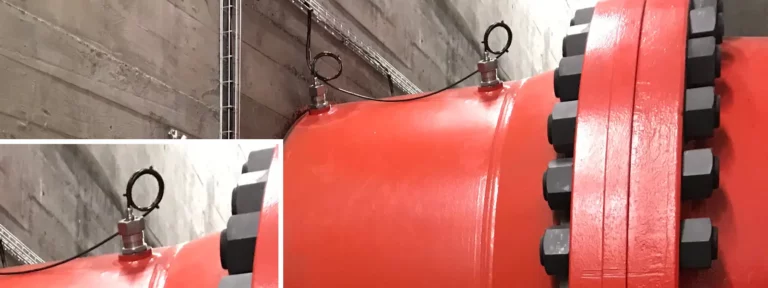
Weld-in sensors are preferred for use in pipelines where the pipes are accessible from the outside. If the pipe wall is sufficiently thick, the sensors are screwed directly in. If the wall thickness is thinner, the sensor is mounted using an additional weld fitting into which it is screwed.
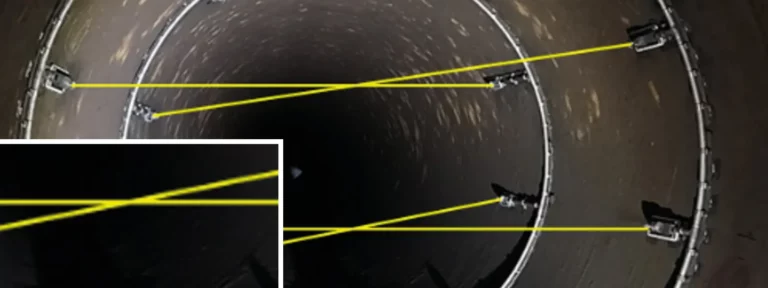
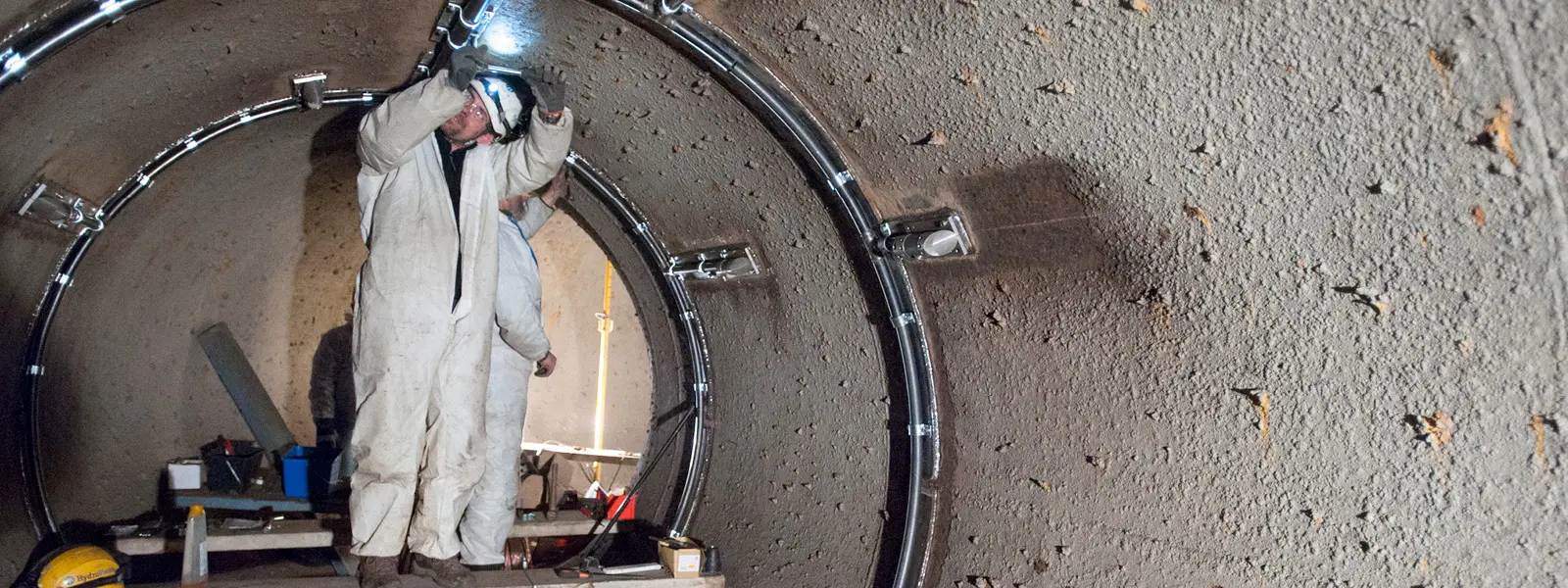
If the pipe is only accessible from the inside, the sensors can be installed directly on the inside of the pipe wall. Additionally, all signal cables from the sensors to where they exit the pipe are run in protective conduits to shield them from the high flow velocities.
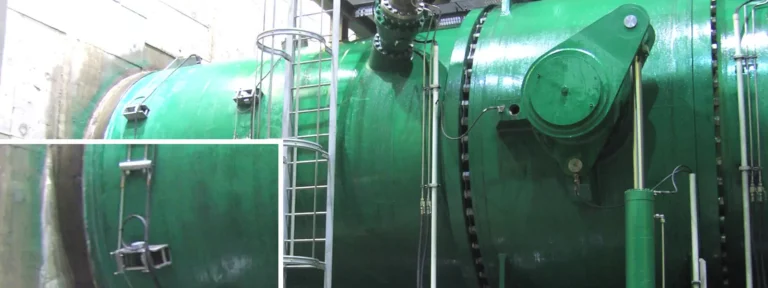
Non-invasive sensors are attached to the outside of the pipe and measure through the pipe wall. The sensors can be installed and maintained with minimal effort and without interrupting the process.
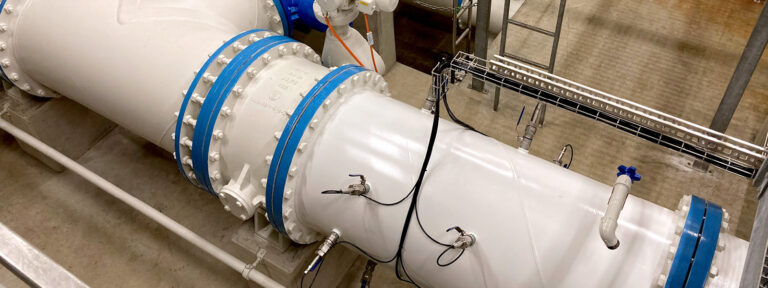
For use in supply lines with flanged measuring points, a fully integrated Ductus solution is available, which can be flexibly configured in terms of length and nominal diameter. This makes Ductus a particularly cost-effective way to upgrade existing measuring points, especially in existing lines.
Are you interested in our services or another customer segment? We look forward to hearing from you.